Kudu in Marloth Park
Kudu are the big grey antelope that step out of the bush at the bottom of the garden, usually early or late in the day. Here's how to tell a bull from a cow and how to give them room.
Kudu are large grey-brown antelope with thin white stripes, and they walk through gardens all over Marloth Park, mostly in the early morning and late afternoon. Only the bulls have horns. Watch them from the stoep or the car, and if you put food out, the rule is antelope pellets and wild bird seed only, never from your hand.
What kudu look like
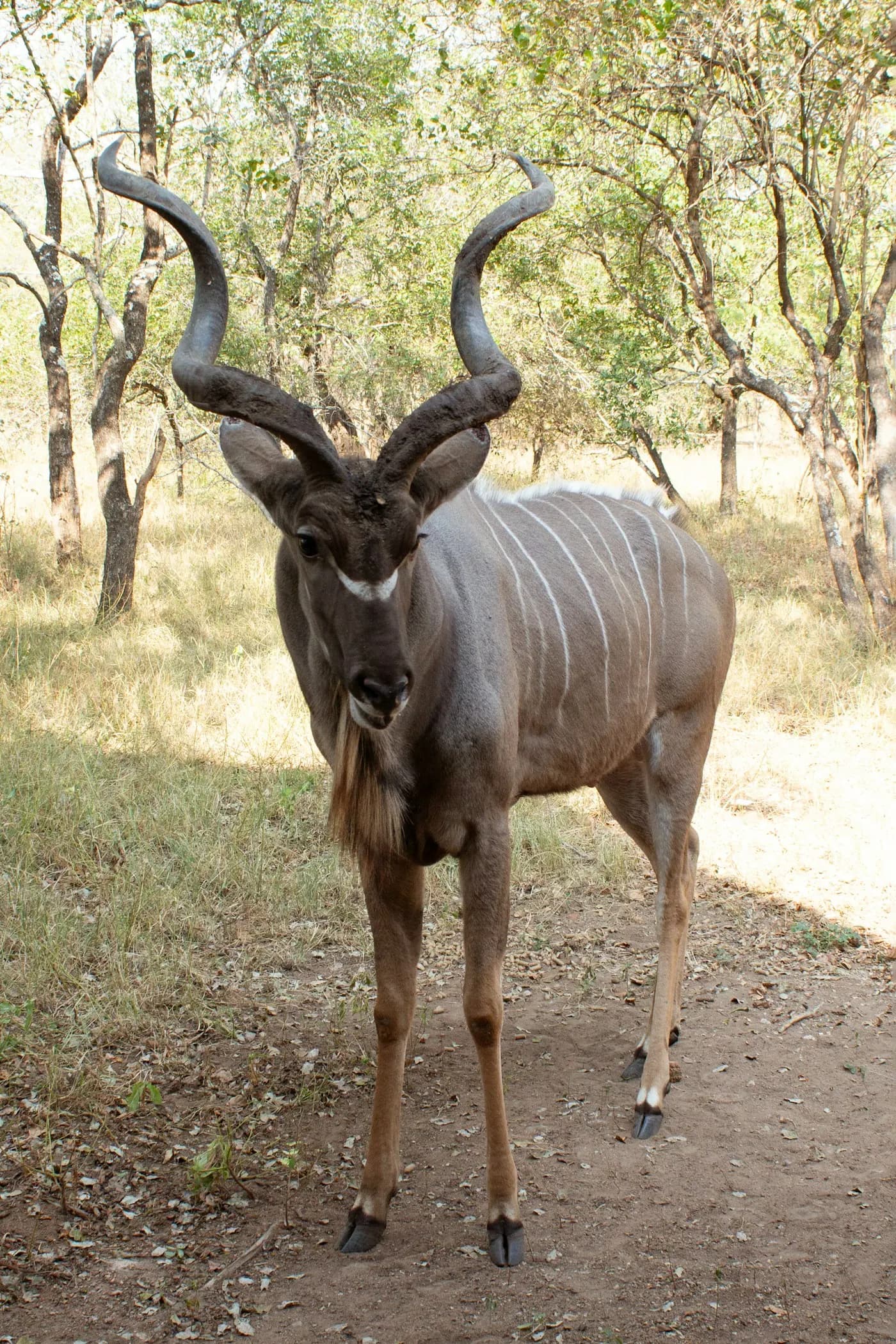
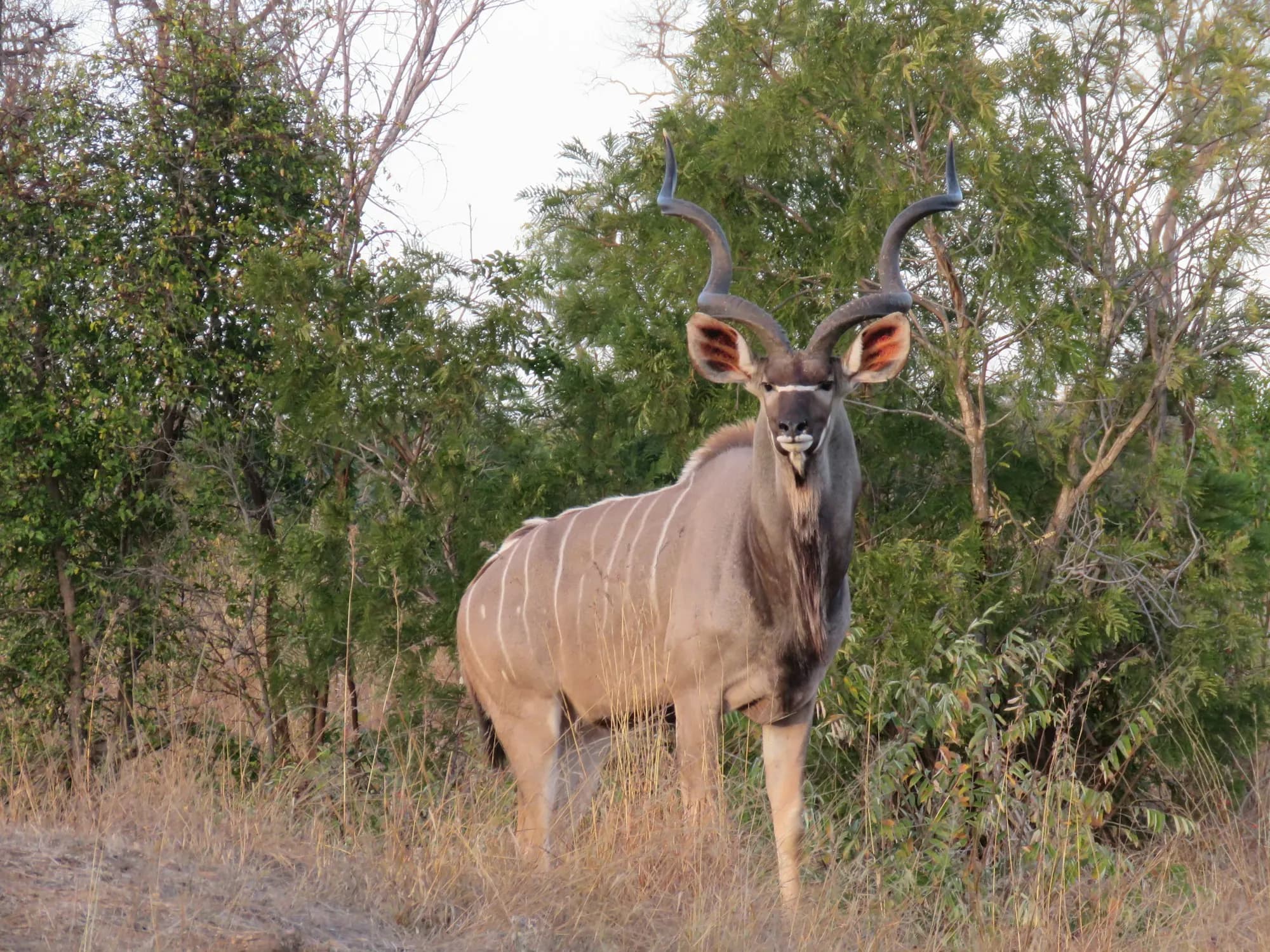
Kudu are tall antelope, grey-brown to reddish brown, with 4-12 thin white stripes down each side and a white chevron between the eyes. Their large ears are sensitive to sound, so they often look up as soon as you step outside.
Bulls and cows
Bulls are much bigger than cows. A bull stands up to 1.6 m at the shoulder and weighs 190-270 kg, and he has a fringe of hair under the throat and long spiral horns. Cows weigh 120-210 kg and have no horns.
You can roughly age a bull by his horns. They start growing at 6-12 months, make their first full turn at about two years and reach two and a half turns by about six.
Kudu or nyala?
Nyala come into the gardens too, and a nyala ewe is easy to mistake for a young kudu cow. She's smaller, at 55-68 kg, and a brighter rusty brown, with ten or more white stripes.
Where and when you'll see them
Kudu live all over Marloth and in Lionspruit. They feed and drink mostly early and late, and spend the hot middle of the day resting in the shade. Cows move in groups of about 6-10 with their young. Bulls live alone or in small bachelor groups and join the cows for the mating season in April and May.
The 2024-25 count found 274 kudu in Marloth. In 2025, 150 were moved out to ease the overgrazing, 22 of them to Lionspruit, so the gardens are a little quieter than they were.
What they eat and the feeding rule
Kudu are browsers. They eat leaves and shoots, some grass and fruit when they find it. You'll see plenty of kudu whether you feed them or not.
If you do put food out, the rule is antelope pellets and wild bird seed only. Scatter it on the ground and step back. Bread and mealies make them ill. Never feed by hand: a bull swinging his head for a pellet can catch you with a horn tip.
How close is too close
A kudu that's uneasy stands dead still and stares at you. Then one of the cows, usually, gives a loud bark and the group runs, tails curled up to show the white underneath. If a kudu stops eating and watches you, you're close enough. Stay on the stoep or in the car.
Kudu jump well, clearing about 2 m with ease, and one can bound onto the road right in front of you. Drive slowly, especially at dusk.
Calves
Most calves are born from January to March, about eight months after the autumn mating season. A newborn lies hidden in long grass or bush for 4-5 weeks while its mother feeds nearby. If you find a calf lying alone in summer, it's usually fine. Leave it where it is and keep away. If it looks hurt, tell your host, who'll know which ranger to call.
By three or four months the calf follows its mother everywhere, and at six months it's fairly independent.
Photographing kudu
The best light is early and late, which is also when the kudu are about. Sit still on the stoep or use the car as a hide, and let them come to you. A shot at eye level, from a low chair, looks better than one from above. Don't call them over or throw pellets to bring them closer for a photo. At night, leave the spotlight off, because spotlights aren't allowed in Marloth.
Questions people ask
Do female kudu have horns?
No. Only the bulls have horns. A hornless kudu with stripes is a cow or a young calf.
Are kudu dangerous?
They're shy and usually walk away. The danger is close up: a bull's horns are long and sharp, so never hand-feed or walk up to one.
When are kudu calves born in Marloth Park?
Mostly from January to March. The calves hide for their first month, so you'll see more of them from about February.
Where can I see kudu in Marloth Park?
Almost anywhere, in the gardens and along the gravel roads, best in the early morning and late afternoon. There are kudu in Lionspruit too. See our wildlife guide for the other animals you'll meet and the rules page for the rest of Marloth's rules.